Tag: scuba nj
Scallops, Lobster, and Training on the Lillian.
by Dave Oldham on Jun.09, 2009, under Dive Log, Instruction, North East Diving, Technical Dives
The Scuba Connection had a charter to the Lillian this week. Wayne was out with a class. With a few of the usual suspects in tow, the Independence got underway. NOAA was calling for thunder storms in the afternoon. The drive out of the inlet was in heavy fog. Once that open up, we could see on the radar that the rain was following us out (a bit early). The worst of it hit before we got to the wreck, and mostly cleared by the time Richie had us tied in.
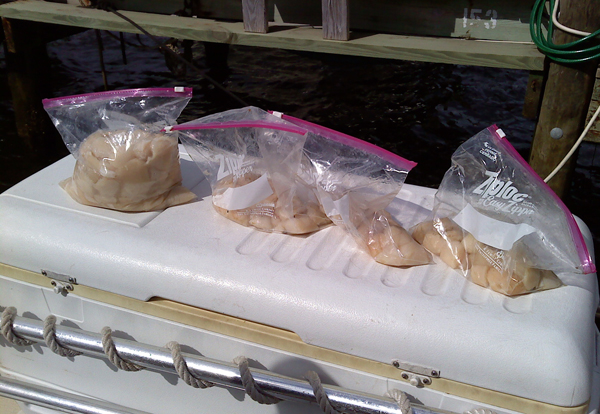
The passengers soon rolled in, and Richie returned with a nice bag of scallops and bugs. He had us tied into a large pipe next to the engine. This section of the wreck stood some 20 ft off the silty bottom. The surface temp was 58. Bottom temp was 43-48, depending on who you asked, and visibility was a dark 40. If the sun came out, this would be a fantastic dive. As it was, it was just great.
The Lillian was a freighter that sunk back in 1939 with a cargo of sugar. It sank in 150 ft of water after a collision in the fog. The wreck is on the edge of the mud hole, so the conditions can vary depending on the tide.
After seeing all the scallops coming up, I figured I’d have to go out in the sand to find any. This proved futile, as the scallops were on the wreck itself. Once I figured this out, I bagged my share just as my reel decided it did not want to go any further. Flounder were all over this wreck. Some were so large, I had to check twice. Many were still buried in the sand. Those I checked three times. Ling cod were also about, along with a few Eel Pouts. One unusual item was the large sponges lodged about the wreck. These seemed out of place here. Some were close to 3 feet across, just laying in the sand. Captain Dan told us to keep an eye out for portholes, so I looked closely as I reeled my line back in.
I headed back to the boilers, and was soon comforted by the sight of the strobe in the distance. These were great conditions for this wreck. Back on the boat, we all took turns cleaning scallops. Several of the passengers had bagged their first scallops, and were learning how to clean them under Captain Dan’s tutelage.
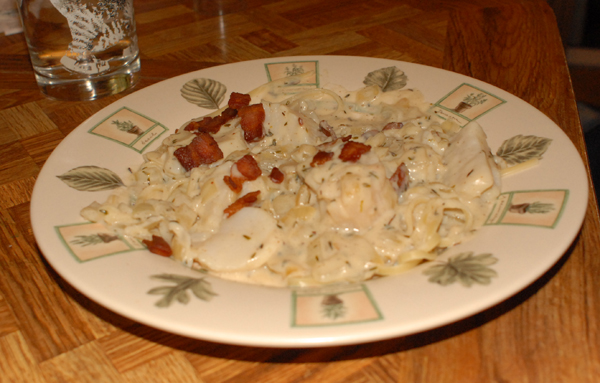
We headed home just as the sun broke through the clouds. Oh well, it was still a great dive! The scallop dinner was good too!
Do you ever see sharks?
by Dave Oldham on Jan.25, 2009, under Basic SCUBA
Yes, all the time. The real question is “are they a danger to SCUBA divers?”
The most common, or plentiful, shark in the Atlantic only grows to a length of 4-5 feet (more commonly seen at 3 ft). They are called sand sharks or Spiny Dogfish. They can be seen around the wrecks either alone, or in small groups. Are they a threat? No. I don’t believe there has ever been an unprovoked attack on humans.
|
|
| Cute little shark. |
Do we see other sharks? Yes, but far less frequently. Further off shore we will occasionally see basking sharks. These are filter feeders, and no threat, but with their large size, they startle you at first. Other divers have reported seeing Blue sharks, and Mako sharks.
Some things to keep in mind. The incidence of shark attacks on divers is very low. Most shark attacks are in shallow water in the surf zone (beach), with limited visibility. Most divers are in deeper water, with good visibility. In recorded history, there have been only a hand full of attacks in New Jersey. None of these have been on divers.
The Wreck of the Delaware - August 18th by Lee Letwin
by Dave Oldham on Aug.16, 2007, under Dive Log
by Lee Letwin:
When we arrived at Clark’s Landing Marina at 6:30 AM, the wind was blowing from the west and we knew we were not going to the Algol, 20 miles offshore. Captain Dan Bartone of the Independence II figured the Pinta was a better choice.
Leaving Manasquan Inlet and heading north, the seas were surprisingly calm but after only 15 minutes we started to get beat up and decided to turn around and head south back to the wreck of the Delaware. The Delaware was built in Philadelphia. She was built as a freighter but during the Spanish -American War was refitted to carry passengers as most of the passenger liners were being used to carry troops. In July of 1898 she left her berth on the East River and was heading to Charleston and Jacksonville. Ten miles out to sea and east of Barnegat she caught fire. All 66 crew and passengers got off safely and were rescued. The wreck, burnt to the waterline, sank two miles offshore just south of Point Pleasant while being towed back to New York by a salvage tug.
All the divers aboard the Independence II did two dives on the Delaware and we all had a great day on the water despite difficult conditions. Our crew included Captain Dan, with Dave Oldham and Bill Trent working as crew. Dave tied us into the wreck wrapping the chain on the shot line solidly around a huge chunk of metal at the bow section of the wreck. There was little chance of pulling off the wreck with Dave’s tie-in despite the conditions. In fact, Captain Dan sent a line to a second dive boat that showed up after us (the advantage of us being on a fast dive boat) and the two boats held tight. Bill Trent played host to everyone and prepared lunch, which was provided as always by Adventure Scuba.
While unloading our gear we talked to the crew of another dive boat docked at the same marina. They had tied into a barge, did one dive and during their surface interval while being tossed about in the waves their anchor line parted. At that point they called it a day.
Its August, and its friken Cold! SS Carolina trip aboard the Independence II
by Dave Oldham on Aug.01, 2007, under Dive Log, Technical Dives
The Independence II made a run out the SS Carolina early Sunday morning. The plan was to stay overnight. To make a long story short, NOAA’s favorable forecast on Saturday night, was revised when we got out there. This cut our trip short, but we still got in some good dives.
Upon arrival, Captain Dan circled the wreck a few times as his depth finder readings did not look right to him. Bill and I jumped in to find the line right beside the wreck, but the wreck didn’t look right. Over the winter, the wreck has collapsed. I recall the starboard side standing some 20-30 ft off the bottom. Now it lay almost flat. Bill was much more familiar with the wreck, and was taken back by what he saw. I guess this explains why Capt Dan was circling. Bill was unable to find his favorite tie-in spot, so we grabbed the closest spot that looked good. One Ling cod was either very interested in what we were doing, or very pissed that we were digging in his hole. Either way he was never more than a few inches from us during the operation.
Vis on the bottom was a clear 50ft, but dark. We tied off a our beacons. Bill signaled “let’s go swimming”, and off we went. Before long we saw some china in the sand, and started to sift through them. It turned out to be mostly shards, but Bill was able to pull out a small ash tray. I had my hands on a large piece of porcelain, but was unable to get it out from under the decking. I was not sure what it was, but it was big, and the hole I was working in was too small for it to move. My planned bottom time was running short, so I signaled Bill and headed back to the line.
Looking at my computer during the ascent, I noticed something I hadn’t before. Its 42 degrees! It’s August, how can it be 42 degrees? That can’t be right, check the backup. Yup, 42 degrees! I could still see the beacons at the first deco stops start at 160, but the thermocline starts back at 50 ft. This was going to be friken COLD. There was little to no current on the line, but the cold started to get really bad. Our work load had prevented us from feeling it on the bottom, but now it started to set in. My body was warm enough, but at that depth, Neoprene gloves lose most of their insulation. Mine are 7 mil, but just looking at them, I can tell they are compressed.
At 70 ft the temp jumped up to 44, and I can actually say it felt good. At this point I was in the surface water which had to be 100+ ft of visibility. I could see Bill’s bubbles rising out of the cloudy layers below. At 50 ft the temp rose to 52 degrees, then at 30 it rose to 78. Now I’m sweating in my suit, but it felt much better. I was a little startled when a large Mula-mula swam right by me on the line. He looked at me for a moment, then swam toward Bill. Due to the cold and workload, I stayed a few extra minutes at the 20 ft stop. I could see Bill as he passed through the thermocline some 70 ft away.
On the surface the seas had turned to 4-6, and the forecast was to get worse tonight. Some of the other divers had passed me on the line. When Bill surface, he and Captain Dan discussed the changes in the wreck at length. Dan geared up and went in. The other passengers came up commenting on the cold. Discussions of numb fingers, and cutting bottom time short. Everyone mentioned the change in the wreck. There were descriptions of large lobsters, but no one wanted to grab them with their cold hands. I guess if they had delayed their dive until we surfaced, they could have switched to dry gloves. Dan had checked out some spots of interest, and came up with a brass shirt hanger.
Other than the cold, the conditions had been fantastic! When I jumped in to pull, the sun was now higher in the sky, and the wreck came into view shortly after the beacon. I didn’t really need my light. If the surface conditions were better, I’d love to have gotten more dives in. This is a great wreck with lots to see.
Diving a Dream, Andrea Doria 2007!
by Dave Oldham on Jul.29, 2007, under Dive Log, Technical Dives
This weekend saw the fruition of a dream, the calumniation of five years of training, hard work and hundreds of dives. Five years ago, I dove the warm, clear, Caribbean waters of Cozumel, and wondered why anyone would dive off the coast of New Jersey. Yesterday, dropping down through the clear blue water off Nantucket, I saw, touched and brought back a small piece of history known as the Andrea Doria!
After the weather turned me back, last year, and again last weekend, I found that there was one spot left on the Independence II for July 29 trip. I wasn’t sure if it would be “third times a charm” or “three strikes, and your out”. Neptune co-operated this time, and the Independence headed out of Montauk in near flat seas with a favorable weather forecast. NOAA’s 2-4 ft seas turned out to be 1-2 at most. The sun was bright and currents tolerable (mostly).
Terry and Mark dropped down an existing morning line, and drifted across the wreck in search of another good tie-in. They were quickly done, and the pool was open. There was current on the surface, but nothing unmanageable. Danny and Brandon were nearly dressed, and quickly got in while the conditions were favorable. Anne and I soon followed.
The water on the surface was clear and blue, but was pushing hard against us. Light penetrated down to the thermocline at 50 ft. Here a cloudy layer was absorbing the light and it quickly became cold and dark. The temp dropped to 47, but down a few feet the vis cleared up a bit. We dropped into the blackness. Down… down… The only thing we can see is the rope and plankton illuminated by our lights. Down… down.. 100, 120… (I’m convinced the boogie man at the bottom is not so scary as his brother Murphy we strap on our backs.) Captain Dan told us the sounder reading to the top of the wreck at 195. When beacons suddenly came into view at 130, I knew the visibility on the wreck was good.
The decent to this point had been hand over hand against the current, but now the current dropped off at 150 ft. I had been monitoring my pO2 and adding gas to the drysuit, but with the current there was no need to put gas in the wing. Dumping gas into it now did not stop my now rapid decent, and I was soon kneeling on the hull. More gas … pO2 is good… more gas…. Ok neutral. Clip off my beacon. OK, breath… breath… Look around. Damn! port holes, port holes, and more port holes. They’re everywhere. However, you can not get to them. They are on the inside, and we are on the outside. Oh well, just interesting to see. The chain was tied in close to the edge of the hull, so over and down. A few smallish openings revealed rooms with tiled floors and hallways beyond. Dropping down, the glow of the beacons above is comforting. Teakwood planks cover the deck, and debris scatters a horizontal area below. Too shallow to be the bottom, but within the beacons glow. Looking around its easy to make out the frame of windows, some with glass. Bottom time disappears quickly, and I’m sure the excitement made it go much faster! Back to the line and the long cold ascent.
The current hadn’t let up. At 70 feet we were suddenly enveloped in a school of small shrimp, krill I think. For a few minutes we were surrounded. Of course you wonder if there are any predators after them. The thermocline at 30 ft brought the temp up to 76 degrees. Boy did that feel good! At this point we are all being blown horizontal like flags, parallel to the Carolina line. Time is dragging… Oops… Why is my pO2 dropping? It’s usually pretty steady during deco. Hit the Kiss valve… Nothing! Shit! I can’t be out. Check the O2 gauge… Zero! Shit! I can’t be out! I’m still at 1.1, but it’s dropping. OK, relax… I’ve got plenty of 50% bailout. Let me check that O2 valve. It’s off? One quick turn, and the friendly hiss if the Kiss orifice can be heard. Apparently the Carolina line had rubbed against the valve and shut it off. Always Know Your pO2!
Back on board, we each discussed what we had seen, and congratulated the Doria Newbies. Dan and Brandon found a port hole they thought could be extricated from it’s surroundings. Terry and Mark had flown across the wreck as the current pulled the line. A few tiles and brass handles made it aboard. We eat and talked and settled down for some R&R as Captains Dan and Jay went in for a look see.
After a nice four hour surface interval, we geared up for round two. Captains Dan and Jay had reported no current, and they were right, it was gone. This time we dropped down the line with no effort at all. I didn’t bounce off the wreck either. The conditions on the wreck were unchanged. Clip off the beacon, tie off the reel, and over the edge. Anne looked left, and I looked right as we passed over the debris. Both looking at the wreck, and for some souvenir of the trip. Again there were the window frames and inaccessible port holes. One of the davits which had lowered the lifeboats stood up majestically out of the chaos below us. Our hopes were for some of the tiles others had reported. Perhaps a nice piece of teakwood could be fashioned into a memento. Again time passed quickly, and despite coming up empty handed, it was an enjoyable dive. As we left the bottom we could hear Dan and Brandon hammering off in the distance. Ascending the line was much more relaxing in the still water, but still cold below 30 ft.
Shortly after surfacing a nice hot dinner was well appreciated. The plan was for an early dive in the morning, then pull the hook and head back. Captains Dan, Jay and Terry entertained us with stories of previous Doria dives, and how much the wreck had changed. Brandon described how he had dropped his hammer into the wreck, and got stuck reaching for it . All the while his buddy, Danny, was video taping the event. There was another round of congratulations for a second Doria dive, and we were soon off to bed. The full moon rose red over the calm ocean as the gentle lap of the waves rocked us to sleep.
Captain Dan splashed early to check the current. Conditions were good, so we soon followed. There was some current on the surface but it was manageable. We had directions to one of the three swimming pools. Again the bottom conditions were great. We headed off over the side and off to the right. Past the davit. Down to 240. Time was starting to run out when we hit pay dirt. There was a huge expanse of tile, some twenty foot on a side. We dropped down to look for some more manageable chunks, and quickly bagged a few. If we can make it back to the windows in time, we can try to shoot one of them also. As fate would have it we were running late, and some monofilament delayed us long enough to prevent the extraction of our second target. That’s OK, our primary target was achieved. Up the line we went, flapping in the building current, holding on for dear life. As we reached the 20 ft stop, the current became variable. One minute you’re at 20, the next you’re almost at the surface, then back to 20. Fortunately this was infrequent, but very disconcerting. I stuck around for a few more minutes of deco to compensate for the washing machine effect. Onboard we found that Terry and Dan had shot up some of the brass windows which Mark swam out on the surface and retrieved. They were now strapped to the deck for the long trip back. Once everyone was up we got under way. No china, but most of us had souvenirs of the trip, and memories for a life time.