Go deep, stay long

Tag: SCUBA

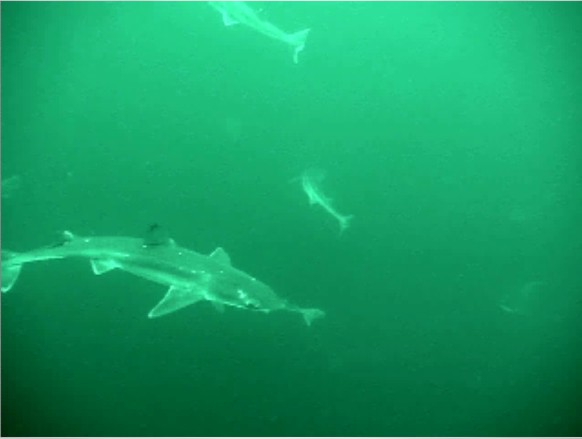
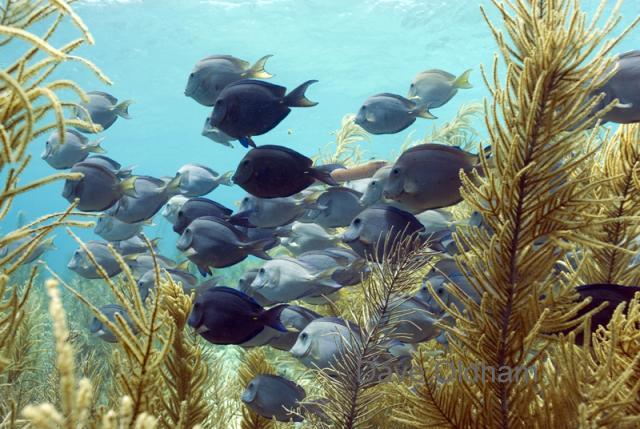
A pack of Dogfish on the Bonanza

by Dave Oldham on May.23, 2009, under Dive Log, North East Diving, U/W Photos

A few weeks back we headed out to the Bonanza. It’s a low lying wreck in 115 ft of water. Typical of many old wooden wrecks, there’s a chain pile and boiler at one end, and a set of wooden ribs on each side. There’s not much between them on this wreck. The Bonanza is far enough off shore that it’s not hit often, and there are often many lobster.

Terry and Frankie tied us in. Frankie came back with stories of giant lobster getting the better of him. Terry came back with the lobsters. Both described a large school of dogfish above the wreck.

I jumped in with the video camera and a new video light reflector.

To make a long story short, there were lots of Dogfish. We figured 80-100. I’m still editing the video, but here’s a clip to give you an idea.

1 Comment :, , more...

Fire coral: Beauty and the Burn

by Dave Oldham on Feb.25, 2009, under Dive Travel, North East Diving

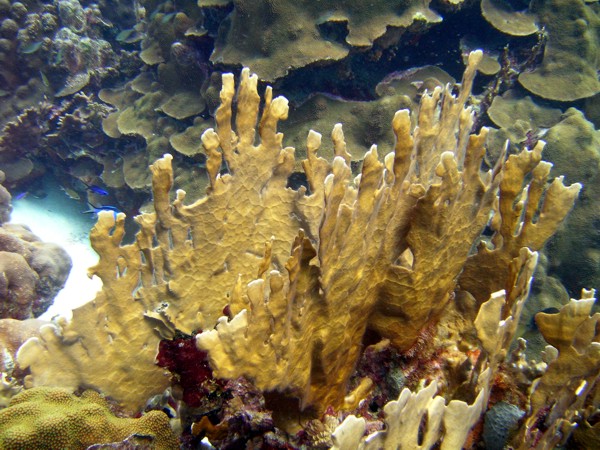
My wife and I enjoy identifying the different fish, coals and critters (aka invertebrates) found on the reefs we visit.   I take pictures and video while diving, then in the evening we review them and try to identify any that we do not recognize.    In several video sequences, I captured the action of small fish darting in an out of leafy coral heads.  At the time I believed blades to be some form of encrusting coral.  Little did I know.

On closer inspection, there were small spines protruding from the surface.  This was fire coral!  After years of hearing divers warning me to watch out for fire coral, I finally found out what it looks like.   I assume the small fish I was observing were using the fire coral for protection from predators as they darted in and out between the blades.

Fire coral is not actually coral, but a hydroid (more like a jellyfish).  The sharp calcified spines combined with the stinging cells called nematocysts present double trouble for anyone that comes in contact.   Bushing against fire coral can produce a painful sting which last for days.  Cutting your skin on fire coral can take long time to heal.  Since we strive to avoid contact with any coral, I’ve never been stung.  Hopefully these pictures will help others to avoid the burn.

Leave a Comment :, more...

SCUBA Exposure Protection

by Dave Oldham on Feb.18, 2009, under Basic SCUBA

In the process of diving, we are subjecting our bodies to an alien environment. This environment exposes our bodies to conditions that we are not accustom. Divers need protection in a few different forms:

  • Thermal protection: The major reason for protection is Thermal protection. Keep in mind that water conducts heat 25 times faster than air. In air, our bodies would be warm at 75 deg F. Underwater, most people would chill very quickly at 75 deg F. Our bodies can not tolerate a drop in temperature. Hypothermia develops after a drop of only a few degrees.
  • Abrasion protection: Rocks, shipwrecks, shells, corals can all easily scratch, or cut through exposed skin.
  • Marine organism protection: especially in tropical waters, there are many stinging organisms both on the reef, and floating in the water. Sea Urchins, scorpion fish, lion fish and a long list of others have sharp if not poisonous barbs that can easily hurt a diver.
  • Sun protection: While not as obvious, the sun in the tropics can burn sensitive skin on the deck of a boat, or even while we are snorkeling in the water.

The type of protection available breaks down into three groups:

  • Dive Skin: These provide no thermal protection, but do provide the other three. They are often made of Lycra to hold the suit close to the body and reduce drag.
  • Wetsuits: These are made of Neoprene rubber, which consists of thousands of small gas bubbles. The thicker the wetsuit, the more bubbles, and therefore the more thermal protection it provides. The thickness is measured in millimeters (mil) and varies form 0.5 - 7.0. A small amount of water enters the suit (hence the name) but the body quickly warms this water, and the suit insulates it from the outside water. In order to work properly, they must be snug to prevent water from flushing through the suit and cooling the body.
  • Drysuits: These provide an airspace under the suit that can be inflated to provide protection. An undergarment holds the air in place around the body and reduces air movement to the highest part of the suit.

Which to use:

Since each diver responds differently to cold, it’s impossible to give an exact answer. Here are some factors that affect how much thermal protection is needed:

  • Water temp: Duh. Colder water will need more protection.
  • Depth: Often it is cooler down deep, and wetsuits will lose some of their protection as we go deeper.
  • Air temp: On an overcast day, it can be cooler in the air than under water.
  • The diver: Size, fitness, metabolism, even what was eaten for breakfast will all affect the reaction to cold.
  • Length of dive: Longer exposures will require more protection.
  • Number of dives: More dives done in a day or over a week can cool our bodies slowly.

There is no right suit for all divers under a given conditions. No one can say “you’ll be warm in a 3 mil suit at 80 deg F.”. However, here are some guidelines:

Dive skins are used in very warm water ( over 85 Deg F ). They have little to no thermal protection, but do provide a layer of protection from sun, scrapes, and stinging organisms. In tropical environments, this protection can be very important. Corals, sea urchins, and shells can cause punctures and abrasions. Also, the Caribbean sun can cause dangerous sunburn very quickly. If you don’t need the thermal protection, it’s still advisable to wear some form of dive skin.

If the water temperature is below 85 degrees, many people should consider a 3 mil wetsuit. At 80 degrees, many will wear a suit between 3-5 mil. On the other hand, some very cold people will where a 7mil suit. As the water get colder, the thickness of the suit can be increased.

Since water temperature varies throughout the year, it can be beneficial to consider layers. A 3 mil shorty can be worn over a 3 mil suit when the weather turns cold. Or, a hooded vest can be warn under a suit to keep the core warm.

Below about 60 Deg F, many people are thinking drysuit. Some will stay with a wetsuit as long as possible due to the cost of a drysuit. For longer dives in colder water, drysuits are heaven sent. With a drysuit, dives under the ice in lakes are possible. To handle cooler temperatures in a drysuit, the undergarment thickness is increased to create a larger air space around the diver. Some exotic materials are often used in the undergarment provide more thermal protection for the same size air space.

Unfortunately, when discussing thermal protection, there is no right answer. It all depends on the diver, and trial and error may be the best approach. One parting point: If you’re warm, you can flush water through the suit, or remove your hood to cool off. If you’re cold, you have to end the dive to warm up. It’s better to error toward the warm side.

1 Comment :, , more...

What is a Rebreather?

by Dave Oldham on Jan.13, 2009, under Tech / Advanced

Many people see my dive gear, and ask “What newfangled contraptions is that”? Ok, maybe they don’t use the word “newfangled”, but you get the point. I dive a Closed Circuit Rebreather (aka CCR). While people think of these as “new”, they actually predate the gear we consider standard SCUBA (also called Open Circuit or OC).

History: Early rebreathers were used not for diving, but for escape. Mines and Submarines both presented situations where a compact breathing device was needed to allow crews to escape to safety. Theses were developed back in the early 1900, and produced in quantity by 1910. Open Circuit SCUBA was not commercially available until the mid 1940s.

How do they work: Let’s start with a quick review of metabolism. Our cells take in food and Oxygen (O2). These are combined to produce energy, but have a toxic byproduct of Carbon Dioxide (CO2). Our Cardiopulmonary system takes some of the O2 from the air we breath, and distributes it to our cells. At the same time it takes the CO2 generated by our cells, and releases it into the air that we exhale. The O2 and CO2 exchanged by our lungs is actually a small percentage of the volume of gas that we breath (about 3%-5%).

On Open Circuit, when a diver inhales, the regulator provides the diver with gas (usually air) at same pressure as the surrounding water. When we exhale, the gas is vented out into the water producing the column of bubbles associated with diving.

When a CCR diver exhales, the gas is vented into a flexible chamber called a counter lung. Within the Rebreather, O2 is added back into the gas, and it is passed through a “scrubber” which removes the CO2. We then inhale the same gas which again contains the proper O2 percentage.

With OC 95% of the gas we exhale has not been affected by our respiration. It is not used. It is wasted. On CCR, this 95% is recycled, cleaned of CO2, enriched with O2, and breathed again. This allows us to make use of smaller tanks, as our O2 consumption does not change with depth.

Leave a Comment :, , , , , , more...

The devil went down to Georgia, and brought a rebreather!

by Dave Oldham on Oct.06, 2008, under Dive Log, Dive Travel

0810Prop.jpg
Prop and shaft

Due to a last minute cancellation, I was able to jump on Richie Kohler’s wreck exploration trip down to Savanna Georgia. Richie and Captain Dan were the crew for the trip. The passengers included Dive Marshall Bill and myself, along with a few of Richie’s students from Canada, and Arizona. The captain was a long time local fishing operator with a long list of hang numbers from 40’ to 300’.

Bill was driving down, and was kind enough to offer transportation of our gear. Since work has been nuts this last month, this allowed me a few extra days before getting underway. We met at the hotel on Friday night, and discussed the plans. We had an assortment of CCRs aboard, and a token OC diver to keep the sharks away.

In this area the slope of the bottom is very shallow, even 30 miles out the depth is only 100ft. Many of the numbers were in 40 - 80 ft. At that depth, decompression is not a consideration, and in 78 degree water, hypothermia is not either. The main issue getting back to the dive shop before it closes.

We loaded up the boat in the morning, and headed out towards Ossabaw Sound. The first set of number (known as secret spot 32) was not so secret. There was a local fishing tournament in progress, and the area was teaming with boats. One boat was anchored over the exact numbers. We moved far enough away to give the boat room, but still could see relief on the depth finder.  Richie dropped in to check it out. The ball started moving off then we saw the tell tail bubbles (never good). It turned out to be reef rather than a wreck. I was unaware that Georgia had reefs, but apparently they do, and this one had 20ft of relief. Personally, I would have jumped in to take some pictures, but the rest of the crew was looking for wrecks. The decision was made to head out for another set of numbers.

0810anchor.jpg
Tied into … the anchor

To make a long story short, we hit a number of hangs before landing on a nice wreck in 45 ft of water. Of all things, Richie had us tied into the anchor which was located next to a large boiler. The wreck was covered in sponge, hard coral, and gorgonians. Navigation was easy in the 50’ visibility. Several rows of beams headed off  toward the bow. Obviously behind the boiler was the engine prop shaft, and prop. A large school of spadefish hung just above the wreck. Barracuda were here and there, often gathering into an ominous school of their own. Within the wreck, particularly the boilers were large grouper waiting for prey. My old friends the seabass were out and about, along with a few large fluke. It was odd to see them swimming around with angle fish, and trigger fish. I expected to see a few lionfish, but there were none to be found.

0810baracuda.jpg
An ominous looking school of baracuda

Swimming about, I found the other divers fanning in the sand near the boiler, engine and around the various wreck structures. When my camera flashed, Richie popped his head out of a cloud of silt with a brass valve in hand. Others held various pieces of porcelain and brass. I entertained myself behind the viewfinder.

Up north, we don’t often get to see wrecks with this amount of light and visibility. Shallow inshore wrecks have the light, but the vis is short. Offshore, deep wrecks have the vis, but there is little ambient light. This was a nice compromise, and I wanted to take advantage of it. The school of spadefish seemed willing to paint a picturesque background for most of the shots. The Barracuda also appeared willing to add to the shots subject matter. This was good, as the divers were too busy to model.

0810spade.jpg
A school of spadefish paint a backdrop

At the allotted time, we started up, and back to the dock. Plans were made for the next day. We cleaned our gear, and headed to bed. It had been a long day.

The offshore forecast was not cooperating, so the next morning we boarded the boat and headed north to Hilton Head. There was an inshore wreck there reported to be producing china and bottles. Upon arrival, Richie jumped in to tie us in. Again this was a shallow wreck at 30 ft with about 15 ft of relief. Had it been in the channel, it would have been a hazard to navigation. We let the other passengers clear the deck, then geared up and splashed.

According to Richie, we were tied into a winch at the bow. I’ll take his word for it, as I could not identify much. The visibility was varied anywhere from 2 feet to 2 inches. The skin of the ship was clear, as were the massive boilers and engine. I tried to find my way back to the props, but was unable to navigate clearly. I kept ending up back at the up line. I tried going along the skin of the ship, but kept finding myself in washouts in pitch black. (Pitch black, and 2 ft of vis is not my idea of fun.) Then I tried to go along the top of the vessel. Here there was light, and lots of spadefish. After passing the boilers, and what appeared to be the engine, I was be back over sand again.

0810toad.jpg
A toadfish I think

After the fourth attempt to find the stern, I heard the worst sound a diver can experience, the boats engines (never good). The engine pattern did not sound like a recall. Perhaps a diver had come up down current, and the boat had to go after him. This would mean that they would go off, then come back and shut down. I reeled in the line slowly heading back. By the time I reached the up line, it was clear that something was wrong. The engines had been running too long. It was also clear that there was no tension on the up-line.

I ascended to find the boat a short way off, the line had parted, and they were adrift. Once I was on the surface they threw me a line, which I quickly attached to the up-line, handed back up. I swam off and waited for the engines to shutdown. Once onboard, Dan explained the details of the incident.

Richie had used a Polypropylene (poly) line for the tie in rather than the standard nylon. Poly line has some advantages in price, and the fact that it floats. On the other hand it does not stretch like nylon, is not as abrasion resistant as nylon, and does not have the strength of nylon. Elastic stretch is good for an anchor line as it absorbs the stress of boat pitching up and down in the waves. In these rough conditions the line had overstressed and chaffed at the bow cleat, and snapped. Lesson learned.

The last few divers eventually appeared. They had varying degrees of success in the hunt for bottles and glassware. None had paid much attention to the sound of the engines.

We strapped down for the trip back to Georgia, and then broke out lunch and hops infused beverages. Richie presented an antique bottle to the captain, who mentioned mounting it with a plaque about “when the rebreathers came to town”.

With the weather picking up, Bill decided to head down to Ginny Springs for a few cave dives. some of the group decided to join him.  However, work was calling so Captain Dan and I opted to head home. Back to those NJ wrecks.

2 Comments : more...

Looking for something?

Use the form below to search the site:

Still not finding what you're looking for? Drop a comment on a post or contact us so we can take care of it!